
Article: The Barefoot Dress Shoe Guide
The Barefoot Dress Shoe Guide
The Barefoot Dress Shoe Guide: I Cut Open All Seven
Prefer to watch? Or read on below.
If you've ever tried shopping for a barefoot dress shoe, you already know it's a mess.
You want something that looks sharp, feels healthy, and is actually built to last. So you spend hours digging online, looking for the one that checks all your boxes — and what you find instead is seven brands making seven versions of the same promise, with no way to tell which claims mean anything.
I've been there. Before I was a founder, I was the guy with fourteen tabs open trying to figure out whether "upgraded full grain leather" was a real thing or just nice words.
So I bought all seven, and I cut most of them in half.
A word about the obvious conflict of interest: I make one of the shoes in this comparison. There was no guide like this when I was searching, so I made one, and I've done my best to be straight with you throughout — including about where my own shoes come up short. You'll find that in the ground feel section, and it's not a small thing.
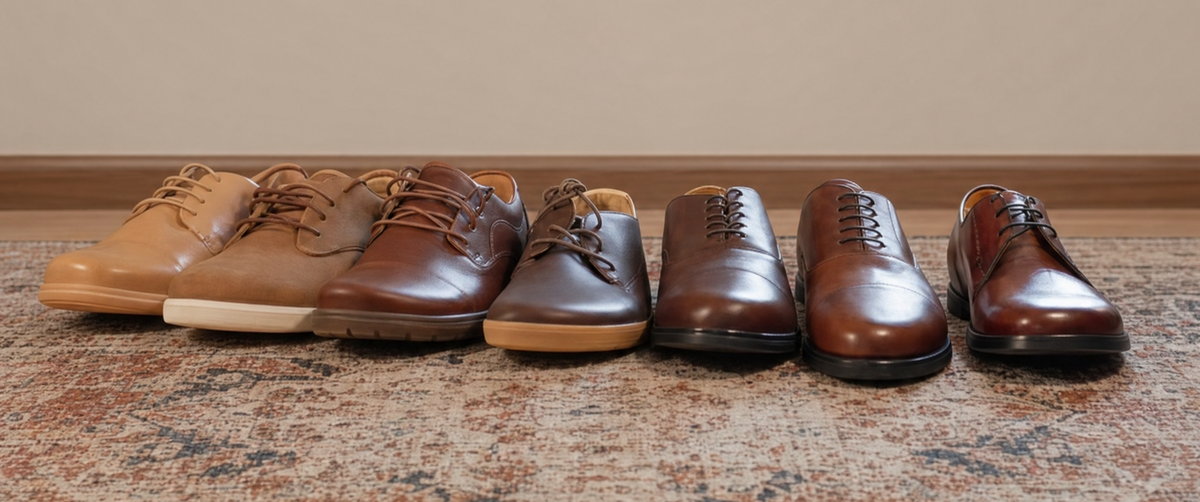
The seven shoes
| Shoe | Price |
|---|---|
| Birchbury Brenston | $120 |
| Xero Shoes Glenn | $130 |
| Lems Nine2Five | $155 |
| Vivobarefoot Ra | $180 |
| Carets FER Cap-Toe Oxford | $250 |
| Freeform Shoes Oxford | $375 |
| Tomás Sullivent Walden | $425 |
Part One: Style
Aesthetics are hard to pin down, because everyone's preferences differ. But there is a general set of standards a population agrees on — proportion, color, overall design. So for this section I'm judging one narrow thing: how well does each shoe fit traditional, timeless dress shoe standards? Not trends. At the end of the day we're buying a dress shoe to use as a dress shoe, usually somewhere formal. Or at the very least to give our outfit some extra panache.
Birchbury Brenston
This is their light tan, which they call “Doe”. My first impression is that it isn't the most refined or elegant shoe in the group. It'll get the job done and it is formal — just not a dressed-up formal.
The leather is very monotone and not quite a natural color. The rubber outsole doesn't read as a natural caramel or gum, which makes the whole thing come off a bit cheap. The shape isn't especially refined, mostly because of the squared-off toe, and there's a little more stitching in places than I'd like.
If I had to label it: workhorse vibes.
Xero Shoes Glenn
Of everything in this lineup, this reads most clearly as a dress sneaker. For versatility, that means it's really only going to work for business casual, not anything leaning towards semi-formal or more formal.
Xero themselves call it a smart casual shoe, and honestly, that's a very good description. It fits.
Lems Nine2Five
The first thing I notice is that the leather comes off very fake. The amount of stitching across the sections and the puffed-up collar perpetuate that same feeling. There’s an elegance in refined minimalism that this shoe lacks, or purposely ignores.
Similar to Birchbury, there's an outsole that comes up around the shoe and veers away from traditional dress shoe shapes. On its own that's not a big deal — but at an event, standing next to people in a circle, it will stand out. That's something to weigh for yourself.
The outsole is very light, which is nice for walking, but it also means it probably isn't going to last a long time. Longevity is not going to be good here.
Business casual, yes. I would not put these on for a wedding.
Vivobarefoot Ra
The leather comes off pretty nice at first glance. I liked it. It's more of a boot leather — rough, waxy, matte — and the gum outsole leans into that natural aesthetic well.
The design is minimal, which I think is a good thing in a dress shoe. Not a lot of different cuts or stitching.
For versatility, though, it doesn't quite hang. Best in a business or business casual setting, and I wouldn't recommend much beyond that unless you're wearing a denim tuxedo.
Carets FER Cap-Toe Oxford
This was one I looked at back when I was a customer, along with Birchbury.
They market themselves as the most stylish barefoot dress shoe, and I'd say they're in the upper tier of aesthetics. Very traditional shape. The leather is quite monotone, which is common for calf leather — especially darker colors. That doesn't automatically mean it's fake, I just prefer more depth in a leather.
The outsole is where I feel it's most lacking. There's a fake rubber welt running around the outside that reads very fake — it has the appearance of a welt without being one.
That said, in a sea of people at an event, I don't think you'd get an odd look from anyone except someone with more sartorial preferences. You can genuinely dress this one up or down.
Free Form Shoes Oxford
I market Free Form as the intersection of health and style, so this is where I have to be careful about my own bias.
At a glance, the leather is nicer — you can see the grain, you can see the characteristics, and there are highs and lows in the depth of color that you don't get from any of the other brands here except Tomás Sullivent. The welt is a true Goodyear welt and it runs around the entire perimeter of the shoe.
As the person who built it, I lean heavily into aesthetics, materials, and construction — that was my priority as a customer, and the brand reflects it.
Where it's honestly weaker: the completely flat outsole does lean more casual. For more formal events, we do offer a 4mm option that bridges that gap, though you're moving away from being fully barefoot when you do.
Versatility is good. Jeans, chinos, an Oxford cloth button-down, or a full suit — none of those combinations will look odd.
Tomás Sullivent Walden
Their line is "you can have it all," a nod to both aesthetics and health.
Another shoe with really nice leather — I was impressed coming out of the box. Beautiful depth of highs and lows in the brown. It looks like it would take a mirror polish very well.
The minimal design is genuinely cool. I like that the vamp and quarter are one continuous piece. I'd have preferred it come up past the eyelets for more of a whole-cut look, but it's nicely done.
There's a stamped-on fake Goodyear welt running around the outside, even though they list Blake welt construction. Some people will feel a certain way about that; personally I don't mind it.
The width, however, is immediately noticeable. Of all these shoes, this is where you'll stand out from a traditional standpoint. It's a very wide shoe.
So: if you're okay with the width, yes, it's versatile. If you want something streamlined, this isn't for you.
Part Two: Materials and Construction
This is the section that matters most for whether a shoe is worth its price, and it's also where most of the industry's misinformation lives.
What the terms actually mean
"Real leather" doesn't always mean real leather. It should, but it doesn't always. What it can mean is that a company had real leather at some point — and a pile of scraps. Those scraps get shredded, pulped, glued back together onto a board or paper or canvas backing, then pressed to look like leather. And it still gets sold as real leather.
"Full grain" doesn't always mean the full grain of the animal, either. You start with the original grain, sure. But when you order from a tannery, you might ask for a three-ounce hide, and they'll take a six-ounce hide and shave it down on the flesh side. You keep the name; you lose some of the benefit. It really depends on what the original starting hide was and how much was removed before it became a shoe.
Construction determines lifespan more than anything else. A Goodyear welt or a Blake welt can potentially last a lifetime if you take care of the upper. A cemented (glued) construction lasts anywhere from six months to a few years depending on wear. And uppers are easy to look after — you basically have to intentionally destroy the upper of a dress shoe.
Throughout this, "consistent wear" means roughly four times a week. If you want some tips on helping your shoes last a lifetime, check out this article.
Shoe by shoe, cut open
Birchbury Brenston — $120
They list the softest full-grain American leather available. That phrase reads really well but doesn't tell you much. Construction is in Vietnam, which isn't a country known for quality footwear, and the rest of the build reflects that.
Inside: a chambered rubber outsole (this makes it lighter, but cheaper than solid rubber), fiberboard, then a foam insole with a faux leather top.
Xero Shoes Glenn — $130
The upper is nubuck. Nubuck and suede are two sides of the same coin: nubuck is the grain side of the leather sanded down, suede is the flesh side. Nubuck is typically more breathable, but it absorbs water and stains more easily.
Inside: glued construction, but I was pleasantly surprised — there's a stitch securing the upper to the midsole. Rubber midsole into foam topped with mesh, plus a removable insole with mesh top and foam bottom. All the lining is synthetic, not natural like the outer, and you can see that delineation clearly.
Honestly, this construction was better than I expected for the price.
Lems Nine2Five — $155
Listed as "upgraded full grain leather" — another nicely worded phrase that doesn't tell us what we want to know.
Inside: this sole was the lightest and by far the easiest to cut through. It's constructed almost exactly the same way as the Xero Glenn. Both are made in China, and I wouldn't be surprised if they come out of the same factory.
Vivobarefoot Ra — $180
This leather seemed the most sturdy of the group to me. The wax finish is hard to read — it may be applied after, or imbued during tanning.
You can resole these; Vivobarefoot offers their ReVivo option, though it's somewhat pricey.
Inside: a very thin layer with a really thin cork top. I'd have liked to see that cork be thicker for better moisture absorption. Sweat can break down materials, particularly adhesives, rather quickly.
Carets FER Cap-Toe Oxford
They list real leather from Mexico. I don't love that term and it makes me skeptical — but the lighter test showed it's legitimate, so credit where it's due.
Inside: a faux Goodyear welt, and the rest is really just glued together. The footbed beneath the insole is recycled rubber and foam. There's nothing holding this shoe together other than glue. The rubber outsole feels soft, but firmer than Lem's or Birchbury.
Freeform Shoes Oxford — $375
(The pair pictured is a wingtip rather than the Oxford — I'd sold the Oxford we looked at earlier to a customer, and this one was already cut. I couldn't bring myself to cut a second pair of my own.)
Real leather sourced from CF Stead in England. Goodyear welt construction, so these can be resoled. All our leather and suede comes from reputable tanneries, and they're listed on our site if you want to check.
One honest note: there's a shank in this particular pair. That's what happens with traditional shoemaking — you talk to your shoemakers and they want to add things like this. We went back and forth, and it's since been removed from the shoes. I left it in here to show you what a shank looks like inside a shoe, and it matters for flexibility: it basically doesn't let the shoe move along that portion.
Inside: a Vibram rubber outsole, a foam board layer, hot agglomerated cork pressed into the cavity that compresses and molds over time, then a full layer of veg-tan leather with calf lining on top. My own pair, three years old, shows very little wear in the materials.
Tomás Sullivent Walden — $425
The highest price on the list. They list top grain leather. Here's what that means: a hide is usually split in half — you get the top grain portion, and the tannery sells the underside as a suede split. It's the tannery saying "we have one article, but if we split it we can sell two and make more money."
Construction is a Blake welt, which is a bit more flexible than a Goodyear welt. It can be resoled, but fewer cobblers have the equipment. This brand does offer resoling services, ranging from $130 to $275, which is quite steep.
Inside: durable rubber outsole, a piece of cardboard that doesn't have much business being in a shoe, a metal shank, a piece of leather board (leather pulp mixed together), a foam midsole, and the Blake welt running through to hold the sole to the upper. There's a calf lining, though in all honesty it doesn't feel like quality calf.
The lighter test
Fake leather melts and crumbles under a flame. Real leather just sits there and does very little.
Everything in this comparison passed. Even where the marketing language made me skeptical, the material itself checked out. Worth knowing — and worth trying on whatever's already in your closet, since it takes about three seconds and won’t damage real leather.
Part Three: The Tests
Toe box
I used the Vivobarefoot Ra as the baseline, since it's the most widely known, and traced each shoe's toe box against it on paper.
- Birchbury Brenston — not quite as much toe shape as the Vivobarefoot, but probably fine for most people
- Xero Glenn — very similar shape to Vivobarefoot, a bit more toe room than Birchbury
- Lems Nine2Five — almost the exact same shape as Xero, which again points at shared manufacturing
- Carets FER — follows a similar line to Birchbury but extends 10–12mm further
- Free Form Oxford — follows the same line as Xero, coming out further; nearly the same shape as those two
-
Tomás Sullivent Walden — clearly the biggest and widest of the group. No questions there, if you’re higher volume this is probably your cup of tea.


Flexibility
This one's a personal grudge. People always want to roll a shoe into a burrito — but feet don't roll into a burrito. It’s a phenomenal marketing visual, and I applaud that; but my PTA background rolls my eyes. To test this I just twisted each shoe along different lines with similar force.
- Xero Glenn — very flexible. More flexible than a foot, frankly.
- Lems Nine2Five — not as flexible as I expected, but still does the job your body needs.
- Vivobarefoot Ra — very high, unsurprisingly. They pioneered the whole burrito thing.
- Carets FER — pretty flexible, your foot will be fine with these.
- Free Form Oxford — not as much as the previous ones, out of the box you might be questioning your purchase (give it time, leather is wonderful at getting more supple with wear)
- Tomás Sullivent Walden — I really had to crank on this one to get it going, that’s mostly the shank preventing the motion along the mid-foot (this is where you get most of your supination and pronation, aka your foot adapting to changes in the terrain)
Thinness and ground feel
Thin is all about ground feel, and it's a a bit of a double-edged sword: the thinner the outsole, the less it lasts. More feel, shorter life, and that adds up in cost over time.
Thinner also might not be what's best for you. Depending on the use case, you may want more material between you and whatever you're walking on. This is really a personal preference. I have had shoes that I love lots of ground feel in, and for dress shoes I really want longevity since the price is higher than most trainers.
Worth mentioning is although the shoes say they are zero-drop quite a few pairs had a drop from heel to toe within the shoe itself. This was mostly because of the outsole and insole shape.
Stack heights-Thin
| Shoe | Without insole | With insole |
|---|---|---|
| Birchbury Brenston | 7mm forefoot / 13mm heel | 11mm / 20mm |
| Xero Glenn | 8mm throughout | 12mm throughout |
| Lems Nine2Five | 12–14mm | 15mm / 18mm heel |
| Vivobarefoot Ra | 6mm throughout | 9mm throughout |
| Carets FER | 13mm throughout | — |
| Freeform Oxford | 18mm throughout | — |
| Tomás Sullivent Walden | 13mm forefoot / 20mm heel | — |
Ground Feel
Birchbury is pretty cushiony, but soft in a way that costs you biofeedback — as the air and foam compress, you get resistance between your sensory and motor feedback, so the response isn't as immediate.
Xero is similar in height but has no chambered insole and denser foam, so the biofeedback is better.
Lems is squishy overall. The sole is firm at first but starts wearing through, landing it between Xero and Birchbury for ground feel.
Vivobarefoot has the best ground feel of the seven, both because of the thinness and because there's simply nothing else in there. Very firm, lots of biofeedback. The most barefoot-feeling shoe here.
Carets has a layer of foam that takes away the firm feel — similar to Xero but squishier.
Free Form is the honest low point. All the layers are firm, so biofeedback is good — but ground feel isn't there, because there's so much material between you and the floor. This is probably Free Form's worst area, and I'd rather say it plainly than let you discover it after you've paid. It's the direct consequence of choosing a welt, a cork bed, and a veg-tan layer over a thin glued sole.
Tomás Sullivent is a bit odd — firmer at the heel, quite squishy at the forefoot. Not the best biofeedback. It’s something you have to experience since it has that dual feeling to it between the heel and forefoot.
Where I Land
I'm glad there are this many options. Every brand is doing something different, and customers can align with whichever one resonates most with them. I'm genuinely glad this niche is growing — other brands are adding more shoes and pushing the whole category forward.
Some closing thoughts to help you decide:
- If ground feel matters most to you → Vivobarefoot or Xero
- If you care more about style and perception → Free Form or Carets
- If you want something really lightweight → Lems, Xero, or Vivobarefoot; Birchbury can jump in there too
- If width is your biggest concern, or you have high-volume feet → Tomás Sullivent. The inherent width is genuinely helpful. Xero, Lems, Birchbury, and Vivobarefoot are also worth a look, since their removable insoles buy you extra volume but not width.
When I look at the big picture — style, materials, construction, barefoot principles, long-term value — Free Form stands apart to me. That's not me trying to push my brand on you. It's simply the reason I built it in the first place: I couldn't find a barefoot shoe that checked all my boxes, so I made one. Seeing them side by side, I still feel that way. I think they deliver the best balance of style, materials, longevity, and classic shape.
Again, if I am buying a dress shoe, it’s to wear semi-formally and formally.
One last plug
Here's something you won't find from most of the other brands here: we didn't stop at one Oxford.
We've built a full line of barefoot dress shoes and boots — Chelsea boots, penny loafers, monk straps, wingtips, even chukkas. Because the truth is that style isn't one size fits all. There's no single shoe that solves every problem or suits every occasion, and your barefoot shoes shouldn't have to either. If you want more than one option, we're one of the only companies giving you that flexibility in your wardrobe.
At the end of the day I want you to pick the shoe that best matches your own priorities. But if you're after something versatile, timeless, and built to last, take a look.
You can always message me through the site. I'm the only one there, so you'll get me right away.
[Watch the full video guide on YouTube →][Shop Freeform Shoes →]